
The Lemurs, the Island, and the Crocodiles I Did Not Ask For

Written by Joni Roberts
Traveler, storyteller, and public health advocate
I want to tell you about the most magical and the most terrifying things that happened to me in Madagascar — and how they both happened on the same day.
Let's start with the magical part.

Andasibe-Mantadia National Park sits about three hours east of Antananarivo, where the highland plateau drops away into the eastern rainforest. The transition happens fast. Within an hour of leaving the capital, the air changes. It gets heavier, greener, older. Tree ferns appear. The road narrows. And you start to have the distinct feeling of entering somewhere that was here long before roads existed and will be here long after.
It should feel old, because it is.

Madagascar has been separated from the African continent for over 88 million years. The species here didn't just evolve differently — they evolved in isolation, following their own logic, answering to their own pressures, arriving at conclusions that the rest of the world's wildlife never reached. Close to 90% of Madagascar's species exist nowhere else on the planet.
The lemurs are the most visible example of that.

You don't have to be a biologist to feel the weight of 88 million years of separation when a lemur looks at you from two feet away. You just have to be paying attention.

I tracked them at the national park first. Early morning. Mist still in the canopy. The Indri — Madagascar's largest living lemur — has a call that I am not going to try to describe adequately, because I don't think language handles it well. Part whale song, part alarm, part something that bypasses your thinking brain entirely and goes straight to the part of you that just feels things. It carries three kilometers through dense forest. Standing underneath it in the mist, I had every hair on my arms standing up.

Then the sifakas — white, wide-eyed, moving through the canopy with a kind of effortless precision that makes you feel like you've been doing everything wrong your whole life. They don't walk so much as flow from one surface to another, and they make it look like rest.
Then came Lemur Island.

If the national park is being invited into the lemurs' world on their terms, the island is something different. The lemurs here have been habituated to human presence in a way that the national park animals haven't. They move toward you. They sit near you. Several species, different sizes, different temperaments — all of them carrying themselves with the calm of creatures who have decided humans are mostly harmless and occasionally interesting.
I saw more species on the island than I could track — the ring-tailed lemurs you'd recognize from any nature documentary, but also smaller, quieter varieties that moved at the edge of your vision like they were deciding how much to trust you.
It's the contrast that gets you. The national park showed me lemurs in their world, in their scale, on their schedule. The island let me understand them differently — closer, longer, with time to notice the individual personalities.

Our guide mentioned, almost as an aside, that there was a time when you could touch them. Hold them. Let them climb on you freely.
After COVID, that changed.
Lemurs, like great apes, are vulnerable to human respiratory viruses. The guides and conservationists made a decision: the experience matters less than the animals. So the touching stopped. The distance is held, even as the lemurs themselves press closer.
They chose the animals over the moment. That's the right call. Even if sitting two feet from a lemur making direct eye contact while knowing you cannot reach out is its own specific kind of feeling.
Now. The terrifying part.
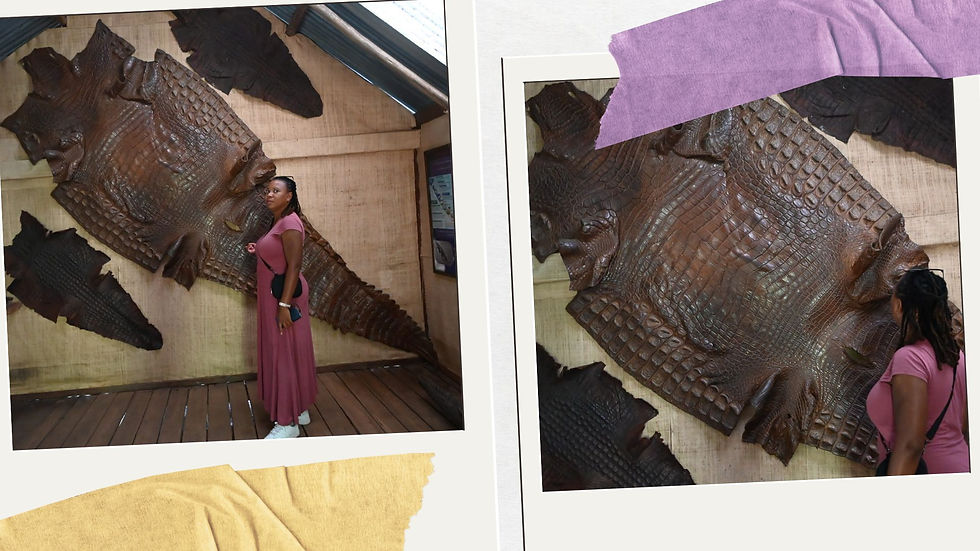
There were crocodiles on the island.

I want to be very clear that I did not come to Lemur Island expecting crocodiles. I came for the lemurs. The lemurs were in the name. Nobody led with the crocodiles.
And yet there they were.
Sleeping, mostly. Utterly still in the way that very large, very ancient predators go still — not relaxed, not inactive, just waiting. Like rocks that have decided today is not the day, but retain the option.
Our guide delivered the information that I would have preferred to receive before I was standing in front of them:

Crocodiles can jump up to a meter in the air.
A meter.
Vertically.
That information was not something I needed to be given while already in proximity to the animals it described.
There is a very specific kind of fear that comes from standing near something dangerous that isn't moving. Because the not moving is temporary. And you don't know when that changes.
I've felt this exact feeling once before. In Tanzania, when I touched a lion. Not a cub. Not behind glass. A real, full-grown lion, in a setting with less distance than my nerves would have preferred. The anxiety in that moment was so specific — a kind of full-body computation, every system running at once. Is it moving? How far is the exit? Could I make it?
The crocodiles gave me the exact same calculation.
Same fear. Different animal. Different country. Same very loud internal monologue.
I would, in retrospect, do both again. Not because the fear wasn't real — it was extremely real — but because that kind of fear makes you more alive than most things do. It pulls you entirely into the present in a way that is genuinely hard to manufacture any other way.
The lemurs were magical. The crocodiles were terrifying.
Madagascar made sure I felt both in the same afternoon. Which, honestly, feels right.


Comments