
The Borrowed Chitenge

Part of The Invisible Rules of Culture Series
What living in Malawi is teaching me about the things nobody tells you.
Written by Joni Roberts
Traveler, storyteller, and public health advocate
"Sometimes belonging isn't about getting everything right. It's about people expecting you to know the rules."
Winter mornings in Malawi have a particular chill.
Not the kind that brings snow.
The kind that makes you reach for another sweater before sunrise and wrap yourself in
an extra blanket before bed.
During clinic season, winter also meant one more thing to remember before leaving the house.
My chitenge.
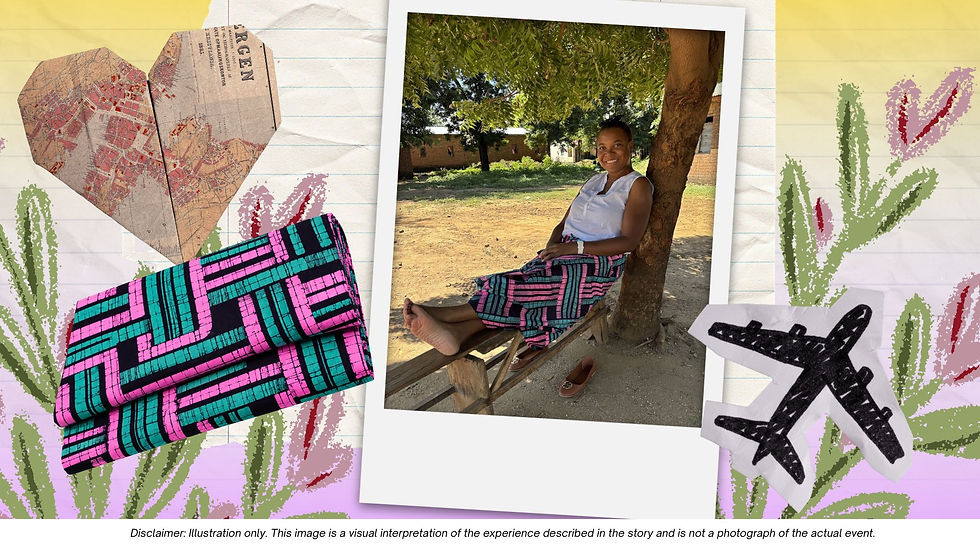
If you've never seen one, a chitenge is a brightly patterned length of fabric that somehow manages to be everything at once. It's a skirt, a baby carrier, a blanket, a head wrap, a grocery bag, a tablecloth, and, if necessary, a curtain.
Its versatility is remarkable.
Whenever we worked in village clinics, I wrapped mine around my waist before we began. Nobody required it. But it felt respectful. I was often wearing jeans—sometimes even ripped jeans—and the chitenge felt like a small way of honoring the community I was entering.
Then one morning...
I forgot it.
I searched my backpack twice before admitting defeat.
Of course.
The one day I forgot my chitenge happened to be the one day I was wearing jeans with holes in the knees.
Perfect timing.
I found Grace.
Grace lived on the clinic compound. She prepared lunch for the staff and somehow managed to make long clinic days feel a little more like home.
I explained my predicament.
Without a moment's hesitation, she untied the chitenge she was wearing.
Then she handed it to me.

Just like that.
The nurses standing nearby burst into laughter.
Honestly...
So did I.
There I was, standing in rural Malawi wearing another woman's wrapper because I'd forgotten my own.
The entire situation was absurd.
And completely ordinary.
What struck me later wasn't Grace's generosity.
Although that was certainly part of it.
It was how unremarkable everyone treated the whole thing.
No one looked at me like a clueless foreigner.
No one teased me for not understanding local customs.
Everyone simply assumed I knew I should have brought a chitenge.
I'd forgotten.
That was all.
Oddly enough, that felt like belonging.
I've spent enough time in Malawi to know that I don't fit neatly into any category.
People often begin speaking Chichewa to me before I open my mouth.
Then I answer in English.
The conversation shifts.
Questions follow.
"Where are you from?"

Eventually we all agree on one thing.
I'm not from here.
And yet...
That morning, no one treated me as though I didn't understand the rules.
They expected me to know them.
The expectation itself felt like acceptance.
It's a strange kind of compliment.
Not because I blended in.
Because I was held to the same standard as everyone else.
Living in another country often means celebrating the obvious milestones.
Learning enough language to greet someone.
Finding your favorite grocery store.
Driving without getting lost.

But sometimes belonging arrives much more quietly.
Sometimes it looks like someone handing you their own chitenge without a second
thought.
Sometimes it sounds like laughter instead of explanation.
Sometimes it feels like being expected to know.

What I'm Learning
This week's invisible rule is that belonging isn't always about being included.
Sometimes it's about being expected to participate in the culture rather than merely observe it.
And that may be one of the kindest forms of acceptance there is.




Comments