
Tana Feels Like Déjà Vu: Finding Bogotá in Madagascar

Written by Joni Roberts
Traveler, storyteller, and public health advocate
I arrived in Antananarivo—Tana for short—in the early hours of the morning.
You know that in-between time of night where it's not quite night anymore, but the day hasn't claimed itself yet? That's when I landed. The kind of arrival where everything feels a little surreal, a little quiet, a little unfinished.

As I rode in the taxi from the airport to my hotel, half-awake and taking in what I could through the darkness, I had a thought I couldn't quite shake:
This feels familiar.
And not just in a vague way. Something about the landscape—the way the city stretched, the way the lights sat against the hills—reminded me of Bogotá, Colombia.
I didn't say it out loud yet. I let the thought sit.
But then morning came.
And as I headed out to my meeting, seeing Tana in full daylight, it clicked.
I was right.
Tana feels like Bogotá.
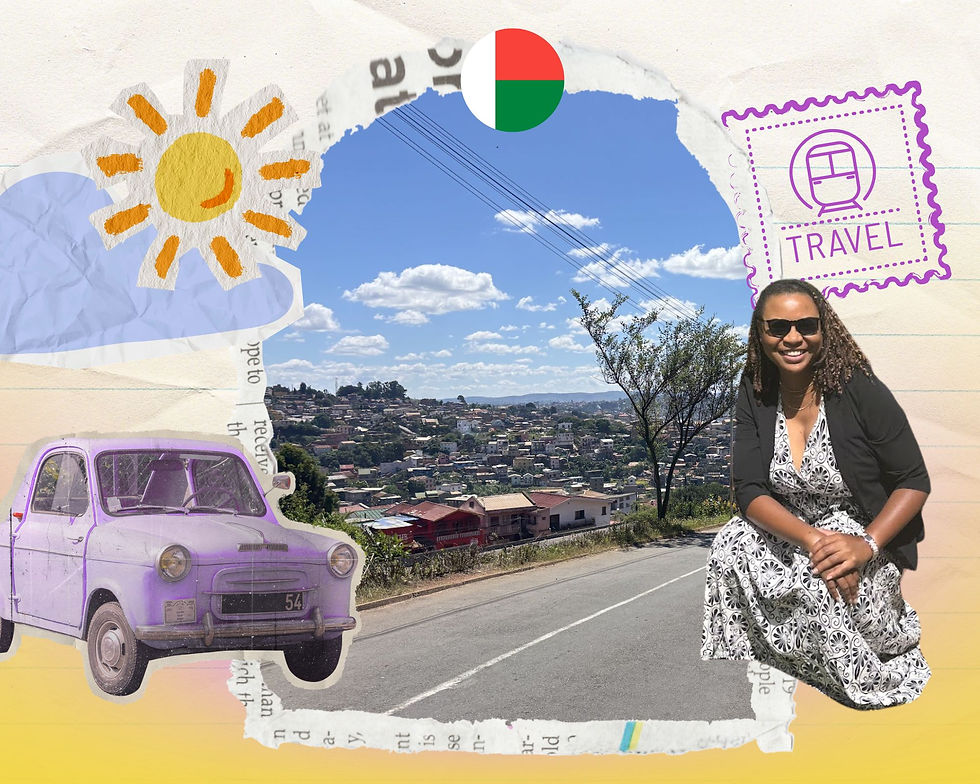
For starters, they're both mountainous cities. Not flat, not sprawling in that predictable way—but layered. Built into hills, shaped by elevation, constantly rising and dipping. Cities that make you aware of gravity.
Even my hotel added to the déjà vu.
It felt almost identical to where I stayed in Bogotá—same kind of structure, same layout, same feeling of being tucked into the city rather than standing apart from it.
And then there was the moment that sealed it for me.
When we arrived, the cab driver didn't just drop me off and leave. He knocked on the gate to make sure someone was there to let me in.
That exact thing happened to me in Bogotá.
Same gesture. Same quiet understanding of safety.
And that theme carried into the daylight too.
During the day, both cities are bustling—full of people, traffic, movement, energy. There's life everywhere you look. But when the sun sets, the tone shifts. In both places, locals let you know not to go out unattended. Not because people aren't kind, but because safety becomes something to think about more intentionally.

It's a shared rhythm:
Alive in the day.
Cautious at night.
And if I'm being honest—if I closed my eyes and just listened to the sounds of the city, I'm not sure I could tell them apart.
The hum of traffic.
Voices overlapping.
Distant movement.
The only thing that would give it away is the language.
Spanish in Bogotá.
French and Malagasy in Tana.
And even that difference tells a deeper story.
Because in some ways, the cities even look similar.
The architecture carries traces of European influence—Spanish in Bogotá, French in Tana. Different colonial histories, but similar imprints. You can see it in the buildings, the layouts, the way certain spaces are structured.
It's a reminder that colonialism didn't just shape borders—it shaped aesthetics, infrastructure, and the way cities present themselves long after.
And yet, each place has made that influence its own.

Both cities have:
A kind of organized chaos—busy, but functioning
Strong street culture—vendors, small businesses, daily hustle
Visible economic contrasts—wealth and hardship existing side by side
Cooler climates than expected, thanks to elevation
A deep sense of resilience you can feel in how people move through the day
But more than anything, they share a feeling.
A sense of being in a place that is alive, layered, and complex. A place that doesn't simplify itself for you—but instead asks you to pay attention.
It caught me off guard, finding Bogotá in Madagascar.
But maybe that's part of what travel does.
It shows you that places you thought were worlds apart can mirror each other in unexpected ways.

And sometimes, in a city you've never been to before, you find a strange kind of familiarity.
Like you've been there before.
Like you already understand a piece of it.
Like, somehow, you've arrived twice.


Comments