
On “Making Friends,” Visibility, and the Blind Spots of being seen
- Joni Roberts
- Jun 11
- 3 min read

Written by Joni Roberts
Traveler, storyteller, and public health advocate
I was catching up with a colleague recently—another foreigner living abroad this year—and we were talking about adjusting, settling in, figuring out work and life in a new place.
Then he asked me a question that made me pause.

“Are you making friends?”
“Yeah,” I said.
Then he followed up with:
“Are they educated?”
I had to stop him there.
“As opposed to what?” I asked.
And that’s when he clarified:
“You know… expats, or local uneducated folks.”
There’s a lot packed into that framing.
I told him honestly: I’m not really in spaces where I’m interacting with people without some form of education, (perhaps clients at the clinic) so that distinction hadn’t even come up for me like that.
But he kept going.
He asked if I go on walks through the community. I said no—I don’t even do that at home.
He said that’s how he’s met a lot of “really cool uneducated people.”
(Not my language—but it matters to keep it visible.)
Then he added:
“It does take a toll though… the celebrity feeling.”

And yes—that part makes sense.
Being a white man in a predominantly Black country, especially in a smaller town, you stand out. People notice you. People approach you. You are visible in a way that carries meaning.
But to be fair—this experience isn’t unique to whiteness or maleness.
It’s what happens when difference enters homogeneity.
I know that because I’ve lived it.
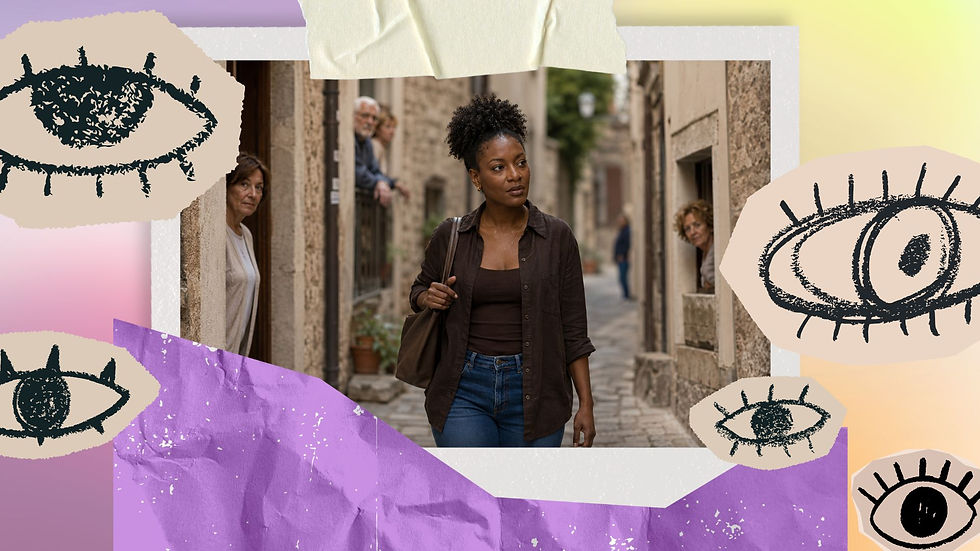
When I lived in a small town in Poland, it was deeply homogeneous. Many people hadn’t left the town—some hadn’t even experienced life beyond its borders in a meaningful way.
And then there was me.

A Black woman in a place where that wasn’t common.
The attention was immediate.
People would approach me in the streets—touch my skin, my hair—curious, unfiltered, sometimes invasive, but often rooted in unfamiliarity more than malice.
One of my fondest memories was a little girl, maybe five years old, pointing at me and saying:
“Mommy, mommy, look—a Black lady!”
Her mother was embarrassed, apologetic.
But I reassured her. Because the truth was simple: her daughter had never seen anyone like me before. It wasn’t shame—it was curiosity.

Another moment—my colleague’s nanny once told me she didn’t know Black people could look “this beautiful.”
An odd statement.
But again, I understood.
Her perception of Blackness had been shaped by limited representations. That comment said more about exposure than intention.
And of course, there were the drunken interactions.
Because alcohol has a way of giving people the courage to say and do things they might otherwise hold back.
But through all of it, one thing was clear:
My relationships in that town were shaped by my difference first.
Yes, people got to know me.
But what drew them in initially wasn’t me as a person—it was what I represented.
Difference.
Curiosity.
Something outside of the norm.
I used to joke that the entire town knew where I lived.
And honestly, that wasn’t much of a joke.
Because when you stand out, it’s hard to hide.
Visibility becomes constant.
And that kind of hyper-visibility changes how you move through the world.
Which brings me back to this conversation—and the public health lens.
Because this isn’t just about social experiences.
It’s about how identity, environment, and structure interact.
In public health, we talk about social determinants—how context shapes behavior, access, and outcomes.
And visibility? Difference? Perceived access?
Those are part of that context.
So when my colleague talks about making friends—about being approached, about feeling like a “celebrity”—that experience isn’t just personal.
It’s structural.
It’s about what he represents in that environment.
Just like in Poland, people weren’t just approaching me—they were responding to what
I symbolized.
And that’s the part that’s easy to miss.
Because when you don’t interrogate it, it feels like:
“I’m making friends.”
But the question we should be asking is:
Are you making friends— or are people responding to what you represent?
And maybe even deeper:
What systems, inequities, and perceptions are shaping the relationships you think you’re building?

Because from a public health perspective, that distinction matters.
It reminds us that:
Interactions are shaped by context
Relationships are influenced by power and perception
“Choice” is rarely just individual—it’s structural
So no—his experience isn’t unique.
But it is revealing.
Because whether in Poland, Malawi, or anywhere else, one thing remains true:
When you are different in a homogeneous space,
you don’t just enter the environment.
You change it.
And it changes how people see—and approach—you.
And if we don’t ask better questions about that—
we risk misunderstanding the very relationships we think we’re forming.


Comments